Sunday, September 18, 2011


The 21st Century Woman – Part II
Herbal Medicines for PMS and Menopause
By Dr. Michael Ruscio

Many women have heard about anti-depressants or birth control for their PMS and menopausal symptoms, but what about natural herbal alternatives?  Let’s take a moment to discuss what herbal medicines have to offer the 21st century woman so that you are aware of all your options.  

In my last article we laid a good foundation, discussing the most common causes of female hormone imbalances.  If you didn’t read the article, the main premise was PMS and menopausal symptoms are usually caused by hormonal imbalances.  Building on this foundation, let’s continue with natural treatments. 

We first need to break down female hormone imbalances as causing two different categories of symptoms; neurological and physical.  Of course the mental and physical symptoms are linked and do influence one another, but to help understand natural treatments it helps to discuss them separately.  


Neurological symptoms typically result from an imbalance in brain hormones, technically known as neurotransmitters.  There are 3 hormones that are of importance.  They are serotonin, dopamine and GABA.  Serotonin makes you feel happy and helps you sleep. Dopamine helps you focus, be energized/motivated, learn and not feel overwhelmed. GABA helps you relax.  Most anti-depressant and anti-anxiety medications work to increase serotonin, dopamine and GABA.  
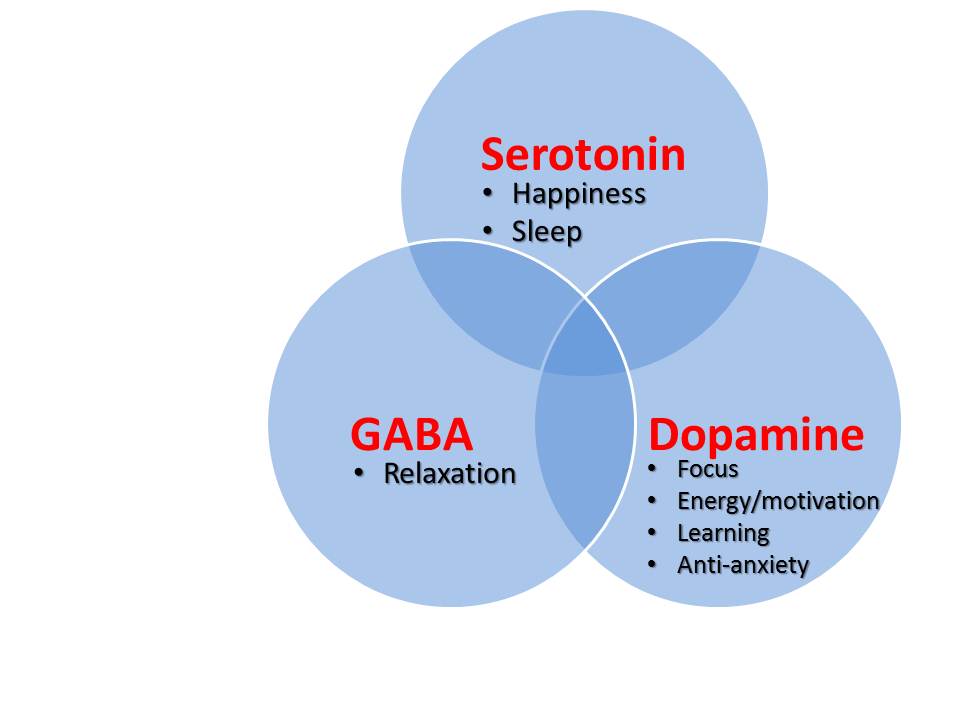

Natural medicines and conventional pharmaceutical drugs can both increase serotonin, dopamine and GABA.  However, natural medicines may provide a safer alternative as the side effects are usually mild to none. Please don’t take my word for it though; we will discuss what current science is showing in a moment. 

Before we do, let’s address the physical symptoms associated with PMS and menopause.  Most physical symptoms are caused by fluctuations or imbalances in estrogen and progesterone. Estrogen and progesterone share a yin-yang relationship, meaning they have to be in the proper balance relative to one another for a woman to feel well.  The beauty of herbal medicines is that they can restore your hormones to the appropriate level whether they are high or low.  This is referred to as a process called adaptogenicity.  Let’s take a brief look at what modern science is showing. 

For all of the following scientific research studies I will provide an ID number.  If you would like to see this study yourself, simply go to www.pubmed.com and type the ID number in the search box.

A very well performed study (17461529) found that combining the herbs Black Cohosh and St. John’s Wort provided significant relief for menopausal symptoms, especially hot flashes.  Shortly after this study, another was published (15863547) showing that in the 304 women studied, Black Cohosh was again an effective treatment for menopausal symptoms. 

Another very effective herb is Chaste Tree (aka Vitex Agnus).  A study published in 2010 (20334585) showed that Chaste Tree was effective for treating PMS symptoms.  In fact, all measured PMS symptoms (mood, water retention, food cravings and pain) were significantly reduced within 3 months of treatment.  Another study of 170 women (11159568) showed a similar positive effect on PMS with Chaste Tree. 

If you’re asking yourself, aren’t drugs more powerful?  You might find this interesting.  A study comparing an anti-depressant medication to Chaste Tree (aka vitex agnus) showed nearly identical improvements in PMS symptoms (12672170).  Let’s not forget about intimacy.  A review of 26 published studies showed DHEA provided mood and libido improvements for women with adrenal fatigue (17208951). 

Herbal medicines have much to offer the 21st century woman.  One word of caution though, please be careful not to self-diagnose and treat.  A skilled clinician can ensure proper use of herbal medicines, especially when it comes to navigating issues of quality control and dose. 
If PMS or menopausal symptoms are bothering you, there is help.  Invest the time and energy to feel better.  Your family, friends, loved ones, and especially You deserve to have the healthiest, happiest version of you. 

For more info, visit Dr. Ruscio’s youtube page, www.youtube.com/michaelruscio, view his recent newsletter, http://conta.cc/oxAiNR, or emailDrRuscio@movepastyourpain.com.   Dr. Michael Ruscio is the director of Functional Medicine at Johnson Chiropractic Group, 115 Town & Country Dr., Suite E in Danville.  925.743.8210 

Wednesday, June 16, 2010

Are Toxins Making You Fat?

By Michael Ruscio
www.IntegrativeHC.com

A recent study published in Obesity Reviews sheds some light on the question of why some people cant lose weight (Obes Rev. 2003 Feb;4(1):17-24). This study scientifically validates what many in healthcare have noted for years; detoxification can aid in weight loss.

This study examined the impact of organochlorines (found in some insecticides and in DDT) and PCBs (found in plastics, ink, rubber and electrical tubing) on fat mass and ability/inability to lose weight. The results; fat mass and BMI were directly related to blood levels of these toxins.

Below: the more toxic a subject was, the more they weighed.

Below: the more toxic a subject the more fat they stored.

Below: the reason some people can't lose weight may be because fat cells store these toxins. As you try to burn fat, these toxins are released causing your metabolism to slow making almost impossible to lose weight. This suggest one has to rid the fat cells of toxins before weight loss will be possible (the "OC" in the diagram stand for organochlorines, a type of toxin).


So what can you do?
I think its obvious at this point, detox. Most detoxes are safe and easy to do. Supplements needed can be purchased at your local health food store. If you have questions on how to get started feel free to email or call or office. (413) 374-0077 office@IntegrativeHC.com

You should also;
  • opt for organic produce & meats
  • avoid storing foods in plastics whenever possible
  • consider a glass or metal water bottle instead of plastic


Sunday, June 13, 2010

What’s wrong with my thyroid?
By Dr. Michael Ruscio
Why do so many people have symptoms of low thyroid function (aka hypothyroidism), yet their lab test are normal. You know something is wrong but your doctor says its all in your head. A study published in Alternative Medicine Review sheds some light on this subject.
Altern Med Rev. 2000 Aug;5(4):306-33.
The summary of this study reports there are a few, fairly common factors, that derange thyroid function but do so in such a way that will not be detectable on standard lab tests which test two markers called TSH and T4. Here are the highlights:

· First we have to understand the concept of activation of thyroid hormone
o Activation of thyroid hormone is when T4 is converted into T3. T3 is the active form of thyroid hormone.
o T3 is almost never tested by standard testing. This is important because even if you have normal T4 you can have abnormal T3. Further, if you have perfect T4 but abnormal T3, you will have symptoms of hypothyroidism.
§ Symptoms of hypothyroidism:
Fatigue High cholesterol
Weight gain Cold hands & feet
Depression Dry coarse skin & hai

Forgetfulness Always cold

· Inflammation decreased thyroid function
o A direct relationship was found between inflammation and decreased thyroid function. In fact, when healthy subjects were injected with inflammatory compounds (specifically IL-6) they developed symptoms of hypothyroidism.
o Don’t think inflammation is a big deal….30.7% of population (that’s 1 of 3 people) has abnormally high inflammatory marker according to a 2006 study.
§ Brain Behav Immun. 2006 Sep;20(5):498-504. Epub 2005 Dec 216330181.
· Toxic metals decrease thyroid hormone activation
o It is well know that people toxic with metals like lead or mercury have hypothyroid symptoms. In fact in another study it was shown that a key thyroid enzyme can decreased in function by 90% after exposure to toxic metals.
§ Heavy metal toxicity is also more common than you would think, people with silver fillings may be at risk for mercury exposure
§ Check out this video to see how silver fillings leech mercury http://www.youtube.com/watch?v=9ylnQ-T7oiA&feature=related
· Increased levels of liver toxicity (hepatic lipid peroxidation) cause hypothyroid symptoms
o As the toxic burden on the liver increased, less of the active form of thyroid hormone (T3) was made (less thyroid hormone was activated)
· Soy may be causing your hypothyroid symptoms
o Healthy subjects who consumed a high soy diet for 3 months developed symptoms of hypothyroidism, after returning to a normal diet their symptoms returned to normal
o Evan as little as 128mg of soy per day caused hypothyroid symptoms in one study performed on a group of women
· High levels of stress hormones also caused symptoms of hypothyroidism. This further reinforces what we have all noticed for decades, when some people are under high amount of stress they tend gain weight.
· Low calorie diets decreased thyroid function
o In men who reduced calories a meager 15% below needed intake showed an unfavorable shift in thyroid hormone levels.
§ How does this work? It’s a prehistoric survival mechanism. When food was scarce (or if you eat like food is scare) the body will slow down its metabolic rate to keep you alive. The slower your metabolism, the less fat you burn.
· A low very carbohydrate diet (less than 200g per day) maintained for too long can decrease thyroid function. This of this as dietary stress.
· This study also showed even if you eat a normal amount of calories but exercise to be in calorie deficit you decrease levels of active thyroid hormone (free T3 and increase reverse T3)
· Sleep deprivation caused a low metabolic state or hypothyroid symptoms.

What can you do?
· Control inflammation
· Rid your body of toxins and limit toxic exposure
· Avoid soy in the diet
· Don’t cut calories and keep your carbohydrates low but now too low, I recommend not exceeding 100 grams per day.
· Manage stress
· Selenium, Ashwaghanda, vitamin E, and gugulu
Visit our website www.IntegrativeHC.com for more information